Discoveries
How Schools Breathed Before Air Conditioning
A postcard’s heating advertisement opens a larger question about warmth and moving air.
01 · What is documented.
The postcard reverse advertises the Columbus System of Heating and Ventilating. That is evidence of what the company claimed; it does not, by itself, establish the school’s exact system.
For broader context, the National Park Service’s Preservation Brief 24 describes nineteenth-century developments including central heating, steam and hot-water radiators, gravity warm-air systems and power-driven ventilation fans. These technologies did not arrive everywhere in one uniform sequence.
What the architect was promising in 1910.
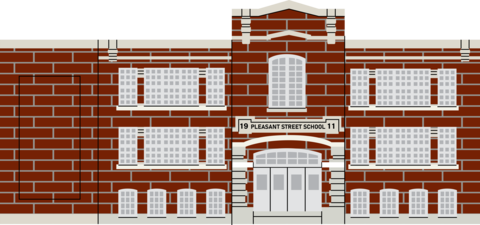
The 1910 Ashland Press proposal for Pleasant Street emphasized heating, ventilation and one-sided classroom lighting. It shows that air and daylight were part of the design argument. It does not establish the exact equipment later installed or prove what survives in the private home today.
A useful distinction.
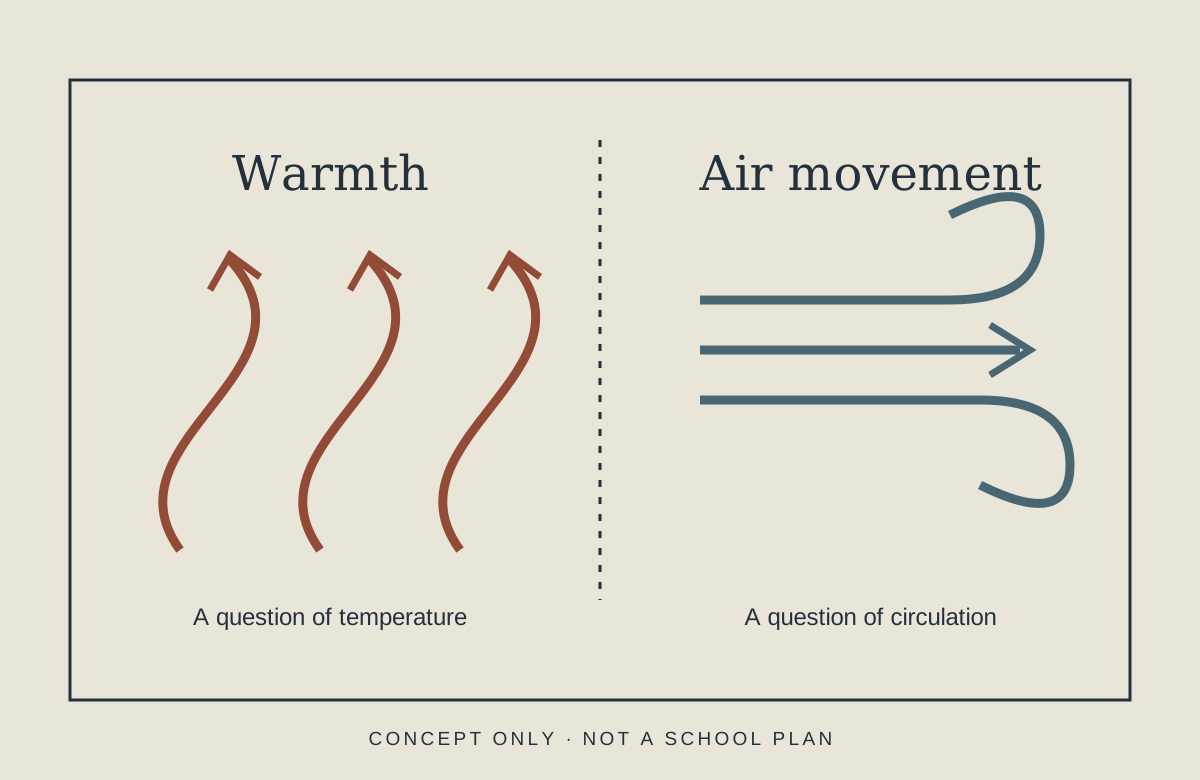
Heating and ventilation are related but different questions: how is warmth supplied, and how does air move through a space?
Historic approaches included architectural features that encouraged air movement as well as mechanical systems. The NPS brief describes operable windows, transoms and other features alongside the development of fan-assisted ventilation. This is general historical context—not proof of features or equipment at Pleasant Street School.
02 · One interpretation.
The advertisement invites us to think about a school as a place where comfort and fresh air were design problems, not just matters of appearance. It gives us a research question, not a completed reconstruction.
An abstract arrow can explain an idea. It cannot show an actual route through this building without supporting records.
03 · Questions still open.
What contemporary specifications survive? Could a dated maker’s document or school record identify what was installed and when? What changed during later alterations?
No equipment model, air-flow figure, surviving installation or precise arrangement is established in this story. It is a historical explainer, not instructions for modifying a building.
Follow the evidence
Sources & further reading
- Owner’s scan of the postcard reverse
The manufacturer’s advertisement is the school-specific evidence used in this story.
- Sharon C. Park, NPS Preservation Brief 24, 1991
General historical context: History of Mechanical Systems, especially pages 2–3. Not evidence of this school’s exact installation.
- Ashland Press, October 19, 1910, p. 1
Bibliographic reference to the corrected scan supplied by Ashland Public Library; no scan reproduced.